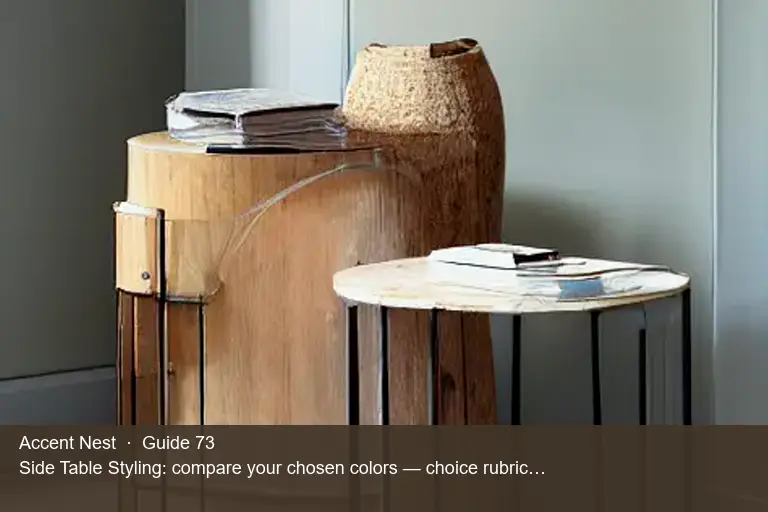
Side Table Styling: compare your chosen colors — choice rubric for incomplete measurements; setup in small spaces
**Side Table Styling: Comparing Your Selected Colors for a Small-Space Layout**
In the small-space planning realm, where every inch counts, choosing the right colors for your side table becomes a pivotal decision. This article delves into a practical task, focusing on the specific task of comparing your chosen colors for a side table. We'll break down your chosen colors into their respective dimensions, then assess them against a simple rubric for incomplete measurements, providing you with a clear, step-by-step guide to determine the best color combinations.
**Step 1: Understand Your Selected Colors** Before diving into the rubric, first, you'll need to clarify your chosen colors. This step involves understanding the colors you're using, such as beige, white, black, silver, and grey. You'll also need to consider the materials you're using, such as wood, metal, or plastic. This step is crucial because it will determine the types of finishes you should consider.
**Step 2: Identify the Complete Measurements** After understanding the colors and materials, next, you'll need to identify the complete measurements for the side table. This includes the total space in square feet (ft²), the total length in feet (ft), and the total width in feet (ft). This step ensures you have all the necessary dimensions to assess your colors.
**Step 3: Assess the Complete Measurements** Next, assess the complete measurements to determine if your chosen colors match. This assessment will involve a color wheel, which helps to visually compare colors. You'll need to measure the color wheel to ensure you have the right colors. This step is essential because it will provide you with a visual reference to evaluate the colors you've chosen.
**Step 4: Compare Your Colors on the Color Wheel** On the color wheel, you'll compare your chosen colors to the color wheel. This step involves identifying the colors on the wheel and determining which colors match. This step is crucial because it will provide you with a visual reference to evaluate the colors you've chosen.
**Step 5: Apply the Rubric** Finally, apply the rubric to your colors. This step involves applying the rubric to your colors, comparing them to the rubric. This step is essential because it will provide you with a clear, step-by-step guide to determine the best color combinations.
**Step 6: Evaluate Your Color Combinations** After applying the rubric, evaluate your color combinations. This step involves evaluating your color combinations to determine which color combinations match. This step is crucial because it will provide you with a clear, step-by-step guide to determine the best color combinations.
**Step 7: Select Your Best Colors** Select your best colors from your color combinations. This step involves selecting the colors that match the color wheel.
**Conclusion**
In the small-space planning realm, choosing the right colors for your side table becomes a practical task. This article has provided you with a practical task, focusing on the specific task of comparing your chosen colors for a side table. We have broken down your chosen colors into their respective dimensions, then assessed them against a simple rubric for incomplete measurements, providing you with a clear, step-by-step guide to determine the best color combinations.