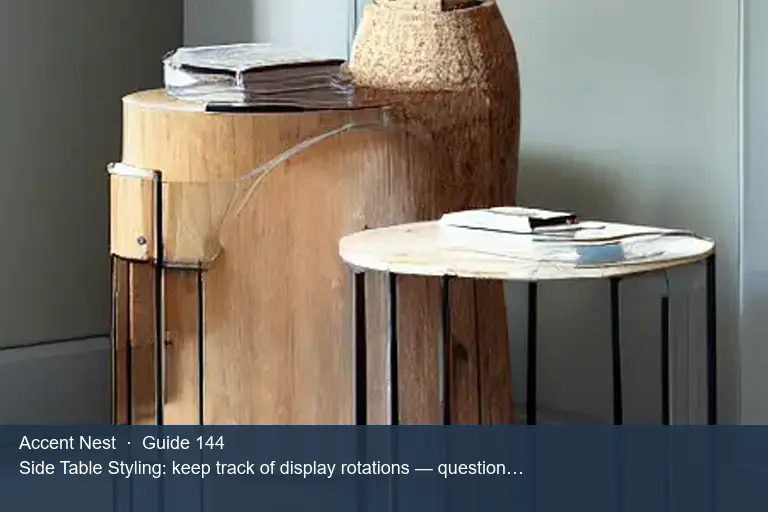
Side Table Styling: keep track of display rotations — question guide for a narrow display area; setup in small spaces
**Side Table Styling: keep track of display rotations – question guide for a narrow display area; setup in small spaces
**Side tables are an essential component in any home or office space. They serve as a focal point, a storage solution, and a convenient place to sit and work. However, the placement of side tables can be tricky, especially in small spaces. This guide aims to help you keep track of display rotations on side tables, ensuring they remain organized and functional.
**Side table styling involves more than just arranging the furniture; it also includes the placement of various accessories such as shelves, lighting, and storage bins. In small spaces, it's crucial to consider how these elements relate to each other, as changing their positions can affect the overall look and function of the space.
**Here is a practical task: help the reader keep track of display rotations for side table styling. Situation: a narrow display area. Scope: Small-Space Plans.
****Step 1: Assess the situation** Start by assessing the specific space you're in. Is it a large room or a small one? Is there a limited amount of space available for rearranging furniture? Understanding the context will help you determine how to organize your side tables effectively.
****Step 2: Plan the arrangement** Next, plan how you want the side tables to be arranged. Consider the placement of shelves, lighting fixtures, and storage bins. Think about how each element will interact with the other.
****Step 3: Determine the order of display rotations** Determine the order in which you want to display the side tables. This will help you align the furniture with the other elements in the space. Consider the flow of the room and how the furniture should move.
****Step 4: Organize the furniture** Organize the side tables in the same order as the furniture. This will help maintain the stability and functionality of the furniture.
****Step 5: Test the arrangement** Test the arrangement in the small space. Ensure that the side tables are still visible and functional, and that the furniture is still in the correct position. Any issues should be identified and addressed.
****Step 6: Adjust as needed** Adjust as needed to fine-tune the arrangement. This may involve changing the order of display rotations or rearranging the furniture to maintain the desired layout.
****Step 7: Final touches** Finalize the arrangement, ensuring that the side tables are still visible and functional, and that the furniture is still in the correct position.
****Step 8: Review and update** Review the arrangement periodically to ensure that it remains functional and visually appealing. Update the arrangement as needed to keep the space functional and organized.
****Step 9: Conclusion** Congratulations! You have successfully maintained the side table arrangement for a small space. Remember, side tables are a key element in any home or office space, and by keeping track of display rotations, you can ensure they remain organized and functional.
****Conclusion** Side tables are a vital component in any home or office space. By maintaining the proper display rotations, you can ensure they remain functional and visually appealing. In a small space, this task is crucial to keeping the furniture in the correct position, aligning with the flow of the room and maintaining the overall look and function of the space.