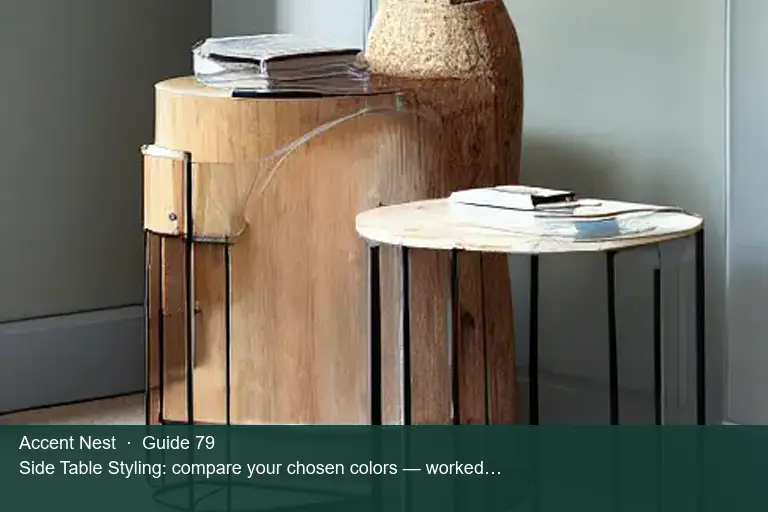
Side Table Styling: compare your chosen colors — worked example for a household handover; setup in small spaces
When a household handover is underway, selecting the right side table to match your style and space requirements is crucial. Below, we'll explore a practical example that highlights how to select the right colors for a small space handover.
**Example: Small-Space Plan**
Let's say you have a small space in your home, perhaps a bedroom or a spare room. You've chosen a side table that fits perfectly with your decor, but you're not sure how to choose the right colors. In this scenario, let's focus on a small-space plan to help you make the right choice.
**Step 1: Understand Your Space**
Start by understanding your space. In this case, it's a small bedroom with minimal furniture and ample natural light. The space is quite small, and you want to use a side table for a functional, yet stylish addition.
**Step 2: Consider Your Budget and Materials**
Next, consider your budget and materials. In this case, it’s a budget of $50. You could either go for a minimalist look or a more ornate one. You might also need to purchase additional materials such as wood, paint, and hardware.
**Step 3: Choose a Neutral Color for the Base**
The first step is to choose a neutral color for the base of the side table. It could be a neutral color like white or grey. This color will serve as the foundation for your table. For example, white could be a good choice. It's a neutral color that allows for easy coordination with other elements in your space, such as furniture, lighting, and decor.
**Step 4: Select a Color for the Accent**
Next, select a color for the accent, which is the part of the table that is visible from the floor. This color should be a different shade from the base color. For example, you might choose a dark grey for the accent, or you could use a different shade of grey for the accent.
**Step 5: Select a Color for the Text**
Finally, select a color for the text, which is the part of the table that is visible above the floor. This color should be a different shade from the accent color. For example, you might choose a dark grey for the text, or you could use a different shade of grey for the text.
**Step 6: Select a Color for the Top and Bottom**
Next, select a color for the top and bottom, which are the part of the table that are visible above the floor. This color should be a different shade from the accent and the top/bottom colors. For example, you might choose a dark grey for the top/bottom, or you could use a different shade of grey for the top/bottom.
**Step 7: Apply the Colors**
Once you've selected the colors, it's time to apply them. You can use a paintbrush, a paint can, or a spray paint to apply the colors. Apply the color for the accent first, then the color for the top/bottom. Then, apply the color for the base, and finally, apply the color for the top/bottom.
**Step 8: Finish with the Text**
Finally, finish with the text. This can be done by painting or by using paint to paint the text.
**Step 9: Display the Table**
Next, display the table in your home. You can place it on a shelf, in a corner, or in a decorative spot that fits with your overall decor.
By following these steps, you can ensure that your side table matches your chosen colors and fits your space. In this case, the small-space handover, the neutral color for the base, the dark grey for the accent, the dark grey for the top/bottom, the dark grey for the text, and the dark grey for the top/bottom.