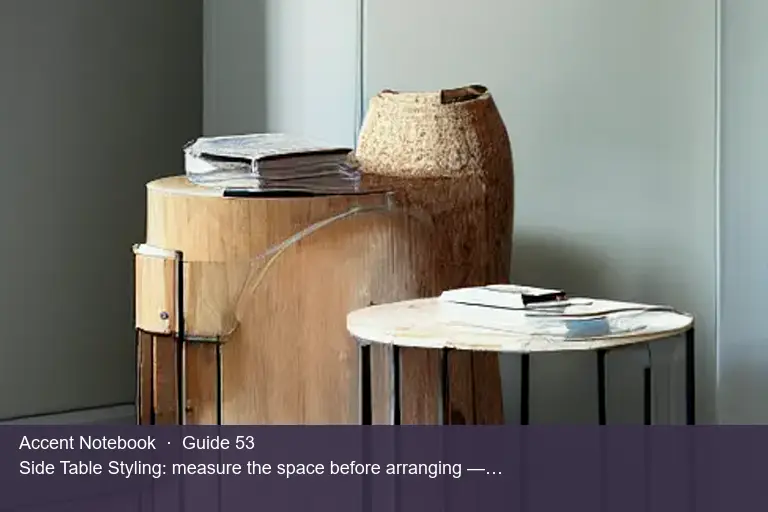
Side Table Styling: measure the space before arranging — consistency test for incomplete measurements; setup with paper records
Side tables can be a stylish addition to any living space, but they can also be challenging to arrange and customize. Before you decide on the perfect style for your side table, it's essential to measure the space before you start arranging. This step is crucial because incomplete measurements can lead to wasted time, wasted materials, and a poorly designed side table. Here's how to measure the space before you arrange your side table.
Step 1: Gather the necessary tools and materials Before you start measuring the space, gather the tools and materials you'll need. You'll need a measuring tape, a ruler, a pencil, and a sheet of paper to record your measurements.
Step 2: Measure the length and width of the space Measure the length and width of the space by using the measuring tape. Start by measuring along the longest dimension of the space, then move to the next dimension, and so on until you reach the shortest dimension. Record your measurements on the sheet of paper. This will give you a clear picture of the dimensions of your space.
Step 3: Calculate the area of the space Measure the length and width of the space again, but this time, calculate the area of the space. The area of the space can be calculated by multiplying the length by the width. This will give you the area of the space in square units.
Step 4: Convert the measurements to a usable format After you've measured the space, convert the measurements to a usable format. For example, if you measured the length as 10 feet and the width as 8 feet, you would convert these measurements to a usable format by dividing 10 by 8, which gives you a usable area of 1.25 square feet.
Step 5: Review the measurements and record the results Review the measurements you've recorded and make sure they match the area of the space you calculated. If you found that your measurement was off by a significant amount, it may be time to revise your measurements or to use a different measuring tool.
Step 6: Apply the measurements to your design Once you've measured the space, you can apply the measurements to your side table design. Consider the length and width of the space and the area you calculated. Use these measurements to choose a side table that complements your design. Make sure the side table is large enough to fit the length and width of your space, and that it's comfortable for you to sit and work.
Step 7: Finalize your side table design Once you've measured the space, you can finalize your side table design. Choose a color scheme that complements the style of your home or business. Use a paper record to record your measurements and design choices. Make sure your side table is aesthetically pleasing and functional.
Step 8: Test your side table Before you decide on the final design, test your side table in a living space. This will help you know if your side table meets your standards. If it doesn't, make the necessary adjustments. Test your side table until you find a design that works for you and your space.
In conclusion, measuring the space before you arrange your side table is essential. This step can help you avoid wasted time, wasted materials, and a poorly designed side table. By measuring the space, you can choose the perfect style and design for your side table. Make sure to review your measurements, convert them to a usable format, and test your design until you find a side table that meets your standards.