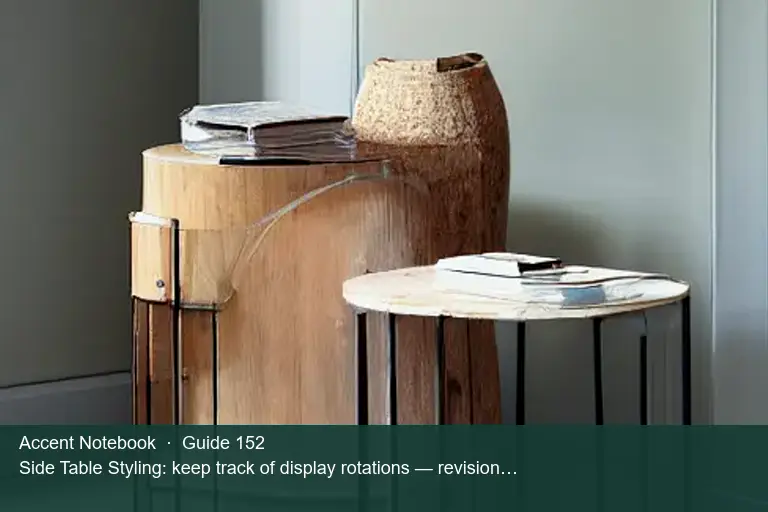
Side Table Styling: keep track of display rotations — revision plan for mixed item sizes; setup with paper records
**Side Table Styling: Keep Track of Display Rotations—Revision Plan for Mixed Item Sizes**
In today's world of technology and fast-paced lifestyles, side tables have become an essential piece of furniture. However, when it comes to keeping track of display rotations, side tables can become a challenge. This article outlines a revision plan for managing mixed item sizes in side table styling, ensuring that each display is rotated correctly.
**Introduction**
Side tables are versatile pieces of furniture that can be used for various purposes, including displaying items, displaying items, or even as a focal point. However, when it comes to managing display rotations, side tables can become a struggle, especially when you have a mix of items of different sizes and heights.
**Reasons for Mixed Item Sizes**
Mixing item sizes can be a challenge, especially when it comes to side tables. For instance, you might have a display of 200g marigolds on the side, but only 50g marigolds in another display. This can lead to confusion and wasted space. Additionally, mixed item sizes can make it harder to keep track of the display rotations, as it might be necessary to rotate each display separately.
**Revision Plan for Mixed Item Sizes**
To manage mixed item sizes in side table styling, you can use a combination of tools and techniques. One of the most effective methods is to use a paper-based record system. A paper-based record system allows you to keep track of display rotations in a structured and organized manner. This system can be easily accessed and updated throughout the day, ensuring that each display is rotated correctly.
**Paper-Based Record System**
A paper-based record system involves the following steps:
- **Create a Record**: Before starting to use the side table, create a record of all the items you are displaying. This can be done using a spreadsheet or a digital spreadsheet. Make sure to include the height, weight, and type of each item.
- **Record Display Rotations**: Once you have created the record, record the display rotations for each item. This can be done using a spreadsheet or a digital spreadsheet.
- **Use a Paper-Based Record**: Use a paper-based record system throughout the day. This can be accessed and updated throughout the day to ensure that each display is rotated correctly.
- **Review and Update**: Review the records daily and update the system as necessary. This can be done using a spreadsheet or a digital spreadsheet.
**Paper-Based Record System Benefits**
The paper-based record system offers several benefits:
- **Efficiency**: The system can be accessed and updated throughout the day, ensuring that each display is rotated correctly.
2.
3.
4.
**Conclusion**
In conclusion, side tables can be a useful piece of furniture, but when it comes to managing display rotations, side tables can become a challenge. By using a paper-based record system, you can keep track of display rotations in a structured and organized manner. With a paper-based record system, you can manage mixed item sizes in side table styling with ease, ensuring that each display is rotated correctly.