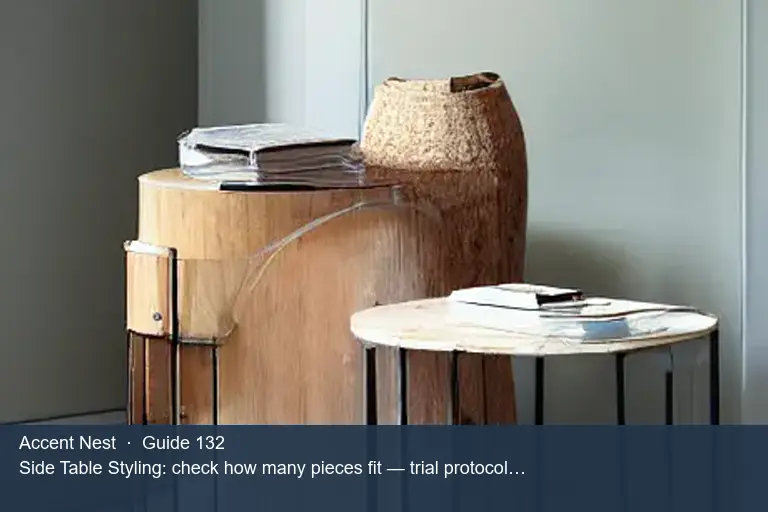
Side Table Styling: check how many pieces fit — trial protocol for mixed item sizes; setup in small spaces
Side table styling: check how many pieces fit — trial protocol for mixed item sizes; setup in small spaces
In small spaces, side tables are essential for enhancing the functional and aesthetic appeal of a room. However, choosing the right size and type of side table can be challenging, especially when the items fit are mixed. This article provides a practical guide to help you determine the best side table size and type for your small space needs.
Step 1: Assess your available space Before selecting any side table, it's essential to measure the available space in your small space. Start by measuring the length, width, and depth of your room. This will give you a rough idea of the size you have available. For example, a room measuring 10 feet by 12 feet would have 12 feet in length, 8 feet in width, and 4 feet in depth.
Step 2: Consider your items and room layout Next, consider the items you have in your room and how they will interact with the side table. If the items are small and light, you might find that the side table can accommodate them. However, if the items are heavier and larger, you might need to consider the placement and arrangement of the items to ensure they won't obstruct the space.
Step 3: Choose the right size and type of side table Based on your measurements and considerations, choose the right size and type of side table. Here are some common types of side tables and their sizing recommendations:
- Standard Side Table:
- 12x8 feet (20x24 inches)
- Fits 10 feet by 12 feet (20x24 inches)
- Ideal for small spaces measuring 12 feet by 16 feet
- Twin Side Tables:
- 12x12 feet (20x24 inches)
- Fits 12 feet by 16 feet (20x24 inches)
- Ideal for small spaces measuring 12 feet by 20 feet
- Compact Side Table:
- 12x8 feet (20x24 inches)
- Fits 10 feet by 12 feet (20x24 inches)
- Ideal for small spaces measuring 12 feet by 16 feet
- Small Compact Side Table:
- 12x12 feet (20x24 inches)
- Fits 12 feet by 16 feet (20x24 inches)
- Ideal for small spaces measuring 12 feet by 20 feet
When selecting a side table, consider the size of the items you have and how they will interact with the table. You may also want to consider the size of the items and how they will be placed to avoid creating obstacles or cluttering the space.
Step 4: Install the side table Once you have selected the right size and type of side table, it's time to install it in your small space. This can be done by placing the table in front of the items you want to display and adjusting the height and angle to ensure they are not obstructing the space.
Step 5: Test the new layout After installing the side table, test the new layout to ensure it is functional and allows you to display the items you have. You can use a mirror to see the layout and adjust it as needed.
Step 6: Adjust and repeat as necessary When you find that the layout is not functional, you may need to adjust the size and type of the side table. Alternatively, you can try installing other side tables in different locations to see if the layout works better.
In conclusion, side tables can be a useful tool for enhancing the functionality and aesthetic appeal of a room. However, when the items fit are mixed, it's essential to measure the available space and consider the items and room layout to choose the right size and type of side table.