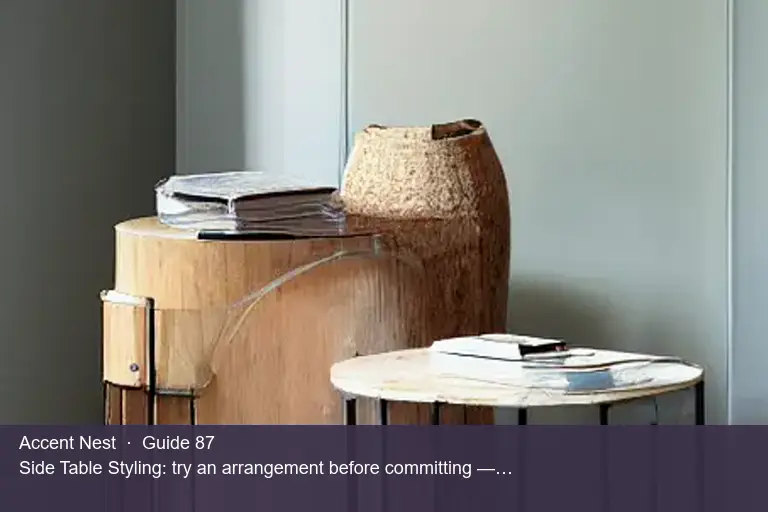
Side Table Styling: try an arrangement before committing — labeling scheme for a short styling session; setup in small spaces
**Understanding Side Table Styling: From Arrangement to Labeling Scheme**
In the world of home decor, side tables are not just pieces of furniture; they are a form of art that can be as captivating or cluttering as the most elaborate decor. A side table can be a focal point in a small space, adding a touch of style and personality. However, choosing the right side table and arranging it appropriately is just as important as the final label for your project.
This article aims to provide you with a practical guide on how to select the right side table and how to arrange it in a small space. The key is to start with the right side table, and then move on to the label.
**Selecting the Right Side Table**
The first step in any project is to decide on the right side table. There are several types of side tables, each with its own unique features and functions. Here are some common types of side tables:
- **Sticky Table:** Ideal for a small space, sticky tables are easy to move, and can be used with most furniture. They are great for creating a focal point in a small room or as a decorative element.
- **Push-Down Table:** These tables are great for small spaces as they can be easily pushed down and can be used with most furniture.
- **Sticky Table with Latch:** These tables have a latch to keep them in place and can be used with most furniture.
- **Push-Up Table:** These tables are great for small spaces as they can be easily pushed up and can be used with most furniture.
Once you have selected the right type of side table, you need to decide on the size and placement of the table. The size should be appropriate for the space you are working in, and the placement should be optimal for the furniture you are using.
**Arranging the Side Table**
Once you have selected the right type of side table and decided on the size and placement, the next step is to arrange the table in a small space. Here are some tips:
- **Use a table frame:** A table frame can help keep the table in place and can be used with most furniture. It is a great way to create a focal point in a small room or as a decorative element.
- **Place the table in a corner:** A corner table is great for small spaces as it can be easily moved and can be used with most furniture.
- **Use a tablecloth:** A tablecloth can be used to add a touch of elegance to the table and can be used with most furniture.
- **Use a table organizer:** A table organizer can be used to organize the items on the table, making it easier to navigate and maintain.
**Labeling the Side Table**
Finally, you need to label the side table. A side table label can be used to give the table a unique name, to identify the items that are on it, and to label the table's materials. Here are some tips:
- **Use a label:** A label can be used to give the table a unique name, to identify the items that are on it, and to label the table's materials.
- **Use a label on the table:** A label can be used on the table itself, to identify the items that are on it, and to label the table's materials.
- **Use a label on the table and on a shelf:** A label can be used on the table and on a shelf, to identify the items that are on the table, and to label the table's materials.
- **Use a label on the table and on a shelf, and on a countertop:** A label can be used on the table and on a shelf, to identify the items that are on the table, and to label the table's materials.
**Conclusion**
Selecting the right side table, arranging it in a small space, and labeling it are all important steps in the process of creating a side table. The key is to start with the right type of side table, decide on the size and placement of the table, arrange it in a small space, and label it. The final result should be a side table that is both functional and aesthetic, adding a touch of style and personality to your small space.