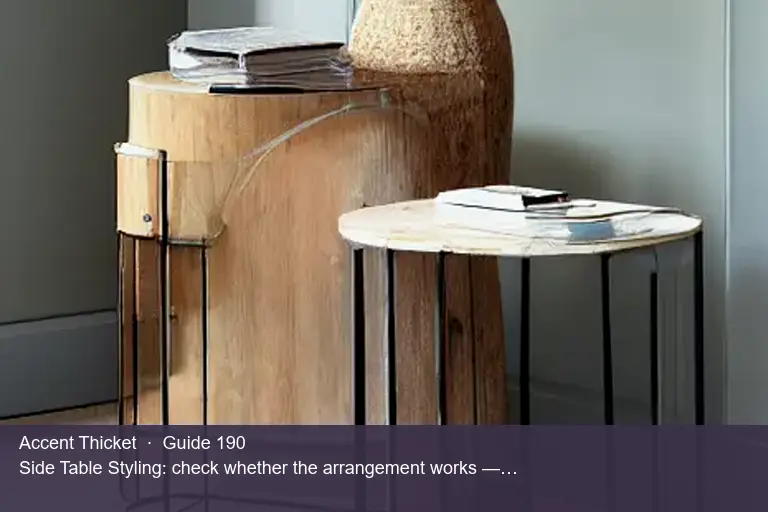
Side Table Styling: check whether the arrangement works — checklist for existing decor; setup after a break
**Side Table Styling: Check the Arrangement Works**
As you sit back and relax after a break, the side table becomes a focal point in your home. Its primary role is to provide a comfortable spot for guests to sit, and its design is essential to its overall function. However, a side table's appearance can affect its overall value and function. In this article, we'll explore a few practical tasks you can perform to ensure that your side table looks good and works well with existing decor.
**1. Assess the Space**
Before you start, it's essential to assess the space in which the side table will be placed. Do you have a floor plan or a layout in mind? Understanding the available space will help you determine the best placement. For instance, if you have a spacious living room, you may need a table that is larger than the room, or if you have a small bedroom, a smaller table might be the better choice.
**2. Check the Existing Decor**
Before you begin, it's always a good idea to check the existing decor in your space. Take a look at the existing furniture and decor in your home. Look for any gaps or gaps in the existing decor, such as gaps in a floor plan, or gaps in a wall or ceiling. These gaps can affect the overall appearance of the space and may need to be addressed before you can start the design process.
**3. Consider the Purpose**
Next, consider the purpose of the side table. Is it for a quiet space, such as a living room, or is it for a dining area, such as a dining room? Knowing the purpose will help you choose the right size and style for your table. For instance, a large dining table might be a better choice for a living room, while a small table might be better for a dining room.
**4. Select the Right Size and Style**
Once you have assessed the space and the existing decor, it's time to select the right size and style for your table. Consider the available space and the purpose of the table. For instance, a large table might be a better choice for a living room, while a small table might be better for a dining room. The size and style should be chosen to complement the space and the purpose.
**5. Start the Design Process**
With the size and style in mind, it's time to start the design process. Use a sketch or a design software to create a rough layout of the space. Use the existing decor in your home to create a reference for your design. This can help you create a layout that is both functional and visually appealing.
**6. Test the Design**
After you've created the design, it's time to test the design. Take a look at the design and see if it looks good in the space. Make sure that the design is functional and that it complements the space and the purpose of the table.
**7. Finalize the Design**
After testing the design, it's time to finalize the design. Make sure that the design is complete and that it looks good in the space. If the design is not complete, make sure it is finalized and that it looks good.
**Conclusion**
By following these practical tasks, you can ensure that your side table looks good and works well with existing decor. Remember, a well-designed side table can be a key factor in making your home a comfortable and functional space.