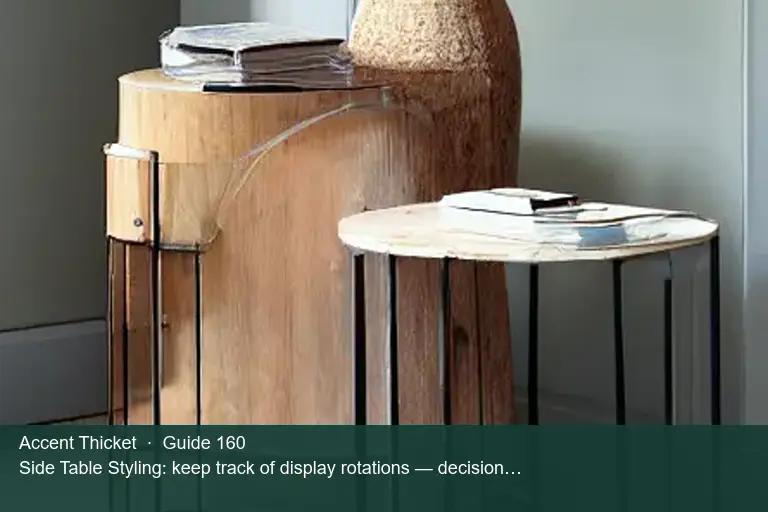
Side Table Styling: keep track of display rotations — decision tree for a household handover; setup after a break
The side table is a staple of a household handover, a time to reconnect with old friends or to make plans for the upcoming week. As the household handover process draws to a close, the side table becomes a focal point of attention, a place where memories are made and plans are discussed. However, the side table's display rotation can be a source of frustration for those with limited experience or for those who take the time to maintain it. In this article, we'll explore the practical task of maintaining a side table's display rotation, and a decision tree to help those in a household handover decide if their side table needs to be updated.
The first step is to assess the current state of the side table. This involves visualizing the current arrangement of items on the table and understanding how they are arranged. The table should be in a well-organized manner, with items either side by side or grouped in categories. The items should be arranged in a logical order, with the most important items at the front and less important items at the back. This helps to ensure that the most frequently used items are at eye level, making it easy to find them quickly. Additionally, it's important to keep in mind the color scheme of the table and the preferences of the roommates. This allows the table to complement the room's style and atmosphere.
The second step is to decide whether the side table needs to be updated. This involves weighing the benefits and drawbacks of updating the table. If the items on the table are not used frequently or if the roommates do not share the same preferences, then the table may not need to be updated. If the items are regularly used, and the roommates have a clear preference for the color scheme and the arrangement, then the table may need to be updated.
The next step is to create a decision tree to help the reader decide if their side table needs to be updated. This can be done by dividing the items on the table into two categories: items that are frequently used and items that are not. Items that are frequently used should be placed at the front of the decision tree, with the most important items at the front. Items that are not frequently used should be placed at the back of the decision tree, with the less important items at the back. This helps to ensure that the most frequently used items are at eye level and that the less important items are easily accessible.
The final step is to implement the decision tree and update the side table's display rotation. This can be done by marking the items on the table with a clear color and arranging them in the order of the items' importance. The items that are frequently used should be marked with a bright color, and the items that are not frequently used should be marked with a less bright color.
In conclusion, maintaining a side table's display rotation is a practical task that can help a household handover decide if their side table needs to be updated. The decision tree helps the reader to weigh the benefits and drawbacks of updating the table and to implement the decision. By following the steps outlined in this article, the reader can keep track of display rotations for a side table and make informed decisions about their household handover process.