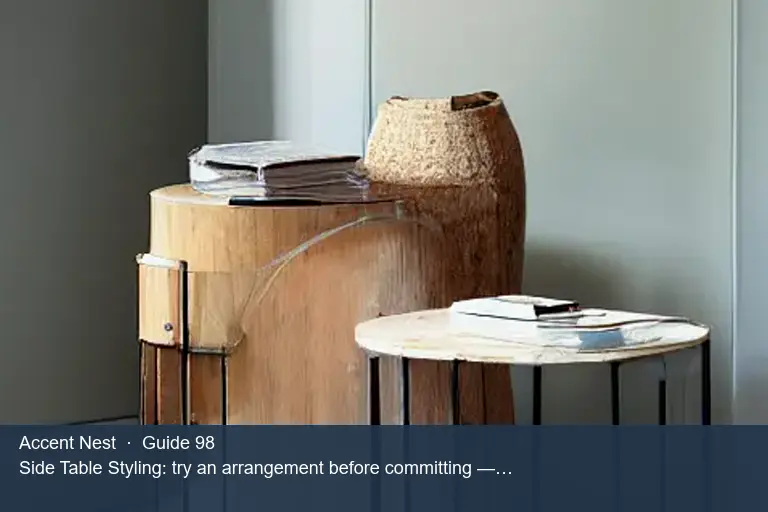
Side Table Styling: try an arrangement before committing — question guide for a temporary arrangement; setup in small spaces
In the world of side tables, arranging them can be a bit like navigating a city street, but with the added challenge of not only choosing the right arrangement but also knowing which one fits into a temporary space. This article will guide you through the process of choosing the perfect side table arrangement for a small space. We will focus on small-Space Plans, which are ideal for those who have limited space and want to maximize their space-usefulness.
To begin, let's discuss the basic elements of side tables. They are typically rectangular in shape, with legs that can be either steel or wood. These legs can be either straight or curved, depending on the style you prefer. They can also be either solid or painted, depending on what you want to add to the table. The base of the table is the part that you are likely to see in the living room, dining room, or foyer.
Now, let's talk about the colors. While you want to choose colors that complement each other, you must also consider how they will look against the other objects in your space. For example, if you have a sofa and a TV, you might want to choose a color scheme that contrasts well with the sofa and TV. On the other hand, if you have a dining table and a TV, you might want to choose a color scheme that complements the TV.
Next, let's look at the material. The material of the side table can be steel, wood, or even a combination of both. Steel is more durable and can be painted, whereas wood is more affordable and can be painted or left uncolored. You might want to choose a material that matches your style or that will look well with your furniture.
Finally, let's consider the size and shape. The size of the side table should be proportional to the living space you are trying to fill. For example, a small living room might need a small table, while a larger living room might need a larger table. The shape of the side table should also be suitable for the space you are trying to fill.
So, let's put these elements together and try out different arrangements. You can start by measuring the width of the space you are trying to fill. Then, you can measure the length of the space you are trying to fill. Next, you can measure the depth of the space you are trying to fill. Finally, you can measure the height of the space you are trying to fill.
After measuring, you can choose a color scheme that will complement the other objects in your space. Then, you can choose a material that will match the style of your furniture. You can choose a size and shape that will fit the space you are trying to fill.
For example, if you have a small living room, you might want to choose a color scheme that complements the sofa and TV, and a material that matches the style of your furniture. You might choose a size and shape that will fit the space you are trying to fill, but still be proportionate to the living space.
Remember, the key to choosing the perfect side table arrangement is to focus on the elements of color, material, size, shape, and depth. The more you think about each of these elements, the more you can tailor your arrangement to the space you are trying to fill. The final step is to try out different arrangements and see which one works best for you.