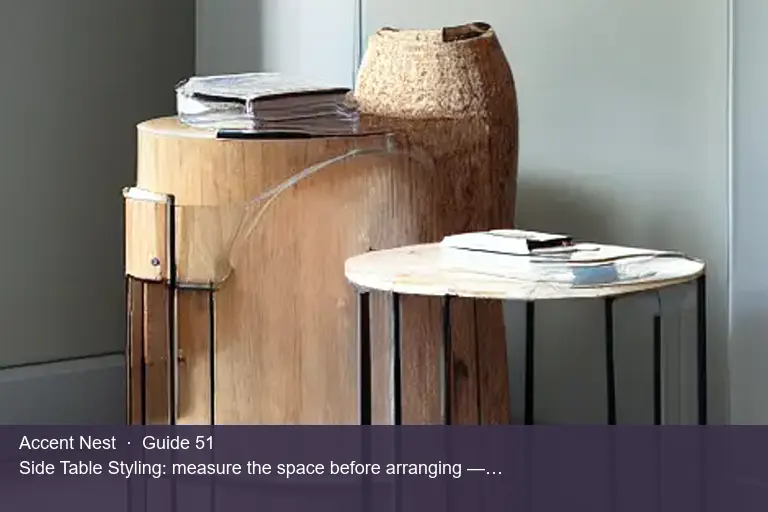
Side Table Styling: measure the space before arranging — change log for mixed item sizes; setup in small spaces
When choosing a side table, it's important to consider the space you're working with. If your space is limited, you may need to adjust your layout to ensure the table fits comfortably. Here’s a step-by-step guide to help you measure the space before arranging for a side table:
- **Identify the Space**: The first step is to determine the size of the space you want to fill with a side table. This could be a small room, a bedroom, a living room, or even a small kitchen. Make sure to note the dimensions of the space.
- **Measure the Length**: Measure the length of your space. If your space is rectangular, measure along the length. If it's a round room, measure along the diameter. If it's a room with irregular shapes, measure the space’s perimeter.
- **Measure the Width**: Measure the width of the space. This can be done by measuring along the length and height of the space.
- **Measure the Height**: Measure the height of the space. If your space is square, measure the height. If it's a room with irregular shapes, measure the height of the space.
- **Measure the Depth**: Measure the depth of the space. This can be done by measuring along the length and width of the space.
- **Measure the Total Area**: After measuring all the dimensions, add up all the measurements to get the total area of the space. This will give you the size of the room in square feet, cubic feet, or other measurements as needed.
For example, let’s say you have a room that is 20 feet long, 10 feet wide, and 6 feet tall. To measure the space, you would:
- Measure the length: 20 feet
- Measure the width: 10 feet
- Measure the height: 6 feet
- Add the measurements: 20 + 10 + 6 = 36 square feet
This means you have a space of 36 square feet. Now you have the size of the room in square feet, which can help you decide on the size of the side table.
If the space is a small room, you may want to choose a small table that is only slightly larger than the space. If the space is a smaller living room, you may want to choose a table that is slightly smaller than the space.
Remember, the size of the table you choose should be proportional to the size of the space. For example, if the space is 36 square feet, a 36-inch table would be appropriate.
In small spaces, you may find it helpful to start with a smaller table that is slightly larger than the space. For example, a 12-inch table would be perfect for a small room.
Once you have determined the size of the space, you can then start to plan your layout for the table. For example, if you have a 36-inch table, you can start by placing the table at the center of the room and then placing a side table on either side of the table.
By measuring the space before arranging, you can ensure that your final layout is as close to perfect as possible. This will help you avoid any potential issues later on during the construction or installation of the table.
In conclusion, measuring the space before arranging is a crucial step in side table styling. It allows you to ensure that the table fits comfortably, which is essential for a successful installation.